
Recently, I had the privilege to participate with Amanin in conducting the online university entrance examination for one of Indonesia’s top universities, supported by an outstanding team of dedicated and motivated invigilators who made the entire process successful and smooth.
It’s remarkable to see how far we have come, not only as Amanin, but also as part of a broader movement shaping the online proctoring industry and education system since our first supported exam in 2023.
According to Kemdiktisaintek (Indonesian Ministry of Higher Education, Science, and Technology), Indonesia had nearly 10 million students enrolled across about 4,400 higher education institutions in 2024. In the same year, 1.48 million people applied for public university admission through SNBP and SNBT, but fewer than 27% secured a spot in their dream university.
Indonesia’s geography, spanning 1.9 million square kilometers and roughly 17,000 islands, presents unique challenges for equal access and quality to education. This is where online proctoring systems can drive profound impact:
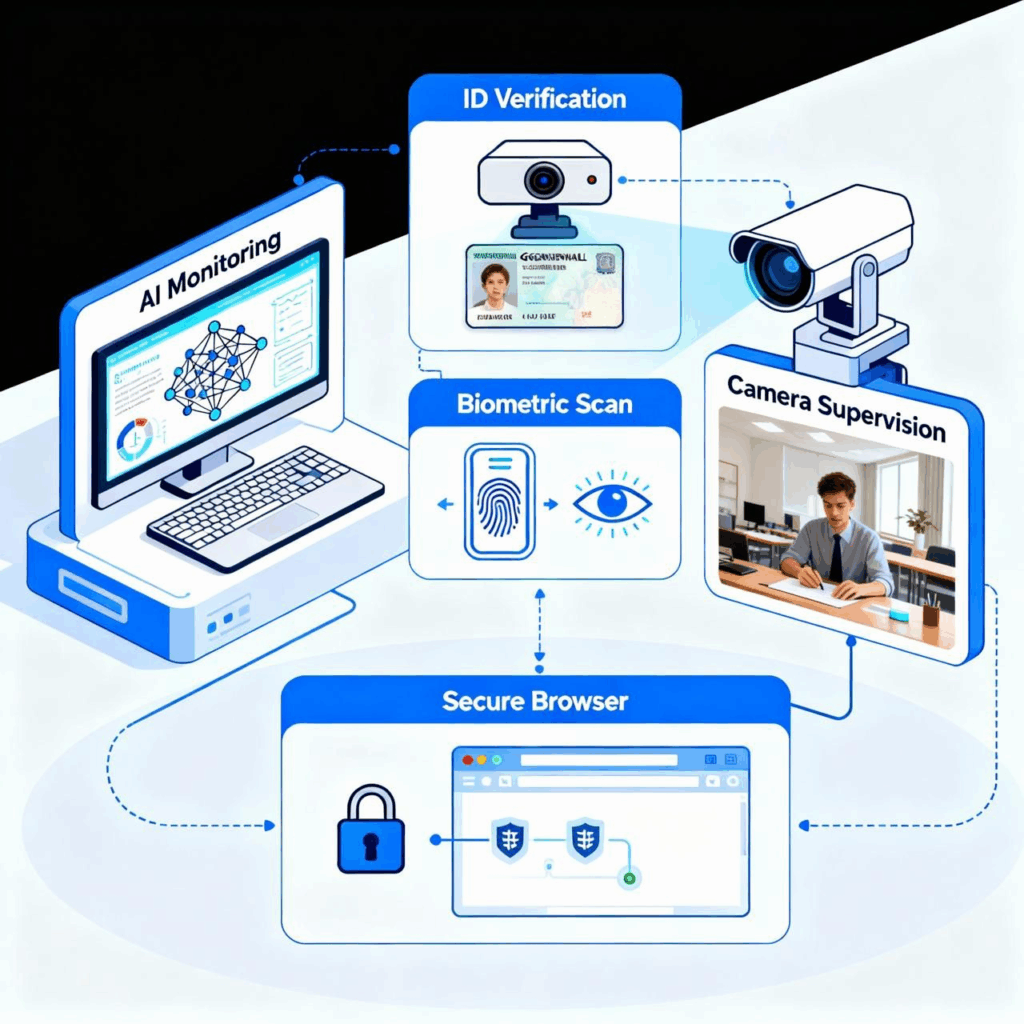
- Reducing academic fraud: AI-driven object detection systems help maintain exam integrity, reducing cheating incidents by up to 73%.
- Real-time monitoring: Continuous webcam and microphone supervision allow instant detection of suspicious behaviors.
- Fair and efficient evaluation: Automation ensures fairness, flexibility, and scalability for exams across vast regions.
- Promoting honesty: Research indicates that proctored systems strengthen students’ sense of integrity and responsibility.
- Simplifying administration: By removing the need for physical venues and paper exams, institutions save time and costs.
- Enhancing security: Biometric authentication ensures exam validity and prevents impersonation.
My recent participation offered lessons that cannot be captured by data or reports alone. Being present allowed me to gain powerful insights
- Understanding firsthand the technical and emotional challenges faced by test takers and invigilators.
- Observing real-time interactions and gathering direct feedback beyond predefined metrics.
- Identifying edge cases and the “why” behind user behaviors that data logs often miss.
These experiences remind me that innovation thrives not only through technology but also through empathy – listening, observing, and learning continuously from real users.
How do you think online proctoring could support your institution or country based on your unique context and use cases?