

Background Story
Anyone who has spent time ensuring GDPR compliance knows it rarely feels tidy. The job begins with good intentions to review key documents from regulators, legal advisors, and corporate checklists. Within minutes, the desktop becomes a jungle of folders, browser tabs, and half-open PDFs that all seem essential. Each source speaks in slightly different terms, versions overlap, and even the structure of the rules can shift mid-page. What starts as a simple cross-check exercise quickly turns into a balancing act between accuracy and attention span.
The challenge grows as the day stretches on. Reading dense policy clauses while toggling between multiple screens is a test of patience and focus. A single distraction can send you back into the spiral of searching where you left off, scrolling through text like a compliance archaeologist. Notes pile up, comments blur together, and suddenly it feels as if the information exists everywhere except in one place. It is a familiar frustration for those trying to stay precise in a world that refuses to stay organized.
Those everyday struggles with scattered documents and fading focus soon crystallize into five specific pain points. Each one piles on quietly at first, then demands far more effort than it should. They transform a routine compliance check into a test of endurance that no product specialist signed up for.
Loss of Concentration
Deep reading of dense GDPR articles demands uninterrupted focus, yet the need to hunt for clarifications or cross-references shatters momentum with every click. A single unanswered question about consent mechanisms or data minimization pulls teams into rabbit holes of secondary searches, leaving half-finished notes and frayed attention spans by day’s end.
Inaccurate Cross-Checking
Manual verification across inconsistent sources breeds uncertainty, as subtle differences in phrasing between Article 5 principles and enforcement case studies create room for misinterpretation. Teams second-guess alignments for features like user profiling or data transfers, risking overlooked nuances that could trigger audits or fines.
Outdated Knowledge Gaps
GDPR interpretations evolve through new rulings, fines, and EDPB opinions, but tracking updates across dispersed repositories feels impossible without constant manual sweeps. Stale references in unchecked tabs lead to reliance on obsolete clauses, exposing products to shifting regulatory risks.
Overwhelming Documentation Volume
GDPR compliance pulls in mountains of material, from 99 official articles to dozens of recitals, EDPB guidelines, and national authority interpretations that span hundreds of pages. Product teams drown in this sheer volume, struggling to prioritize essentials amid endless cross-references and appendices that blur critical boundaries like lawful basis versus legitimate interest.
Ambiguous Interpretation Risks
Vague terms like “appropriate security” or “pseudonymization” invite endless debate across legal, engineering, and product stakeholders, as examples from one jurisdiction clash with another’s enforcement priorities. This ambiguity stalls alignment on implementation details, fostering prolonged discussions that delay feature rollouts and heighten exposure to subjective regulator scrutiny.
Now imagine a better scenario. You begin your compliance review with clarity, not another tangle of scattered PDFs and browser tabs competing for attention. No more guessing where your focus went between dense Article recitals, cross-checks across EDPB guidelines, and quick dives into jurisdiction-specific rulings that derail your momentum. The GDPR QnA Platform quietly centralizes credible sources while you stay immersed in analysis. It indexes the regulations, surfaces precise answers conversationally, and reveals alignments that genuinely matter. Instead of wrestling fragmented documents, you finally gain confidence in interpretations that keep products airtight.
That is what inspired me to create it. After too many hours lost to toggling windows and rebuilding context from vague clauses, I wanted something that truly supported compliance workflows. The GDPR QnA Platform is built to be intuitive and reliable, a tool you lean on without breaking stride. It transforms chaotic document hunts into focused dialogues with authoritative sources, highlighting nuances like data minimization or consent validity. It is not about memorizing every recital, but about understanding GDPR intricacies and using that clarity to review, align, and build with unshakeable precision.
Product Definition
Say hello to the GDPR QnA Platform, a personal project I built to turn chaotic GDPR compliance reviews from a maze of scattered documents into a clear and focused experience. This intuitive yet powerful tool helps product specialists query official regulations, guidelines, and credible sources conversationally while visualizing alignments across articles and recitals. It removes the tedious parts of tab-juggling and manual cross-checking so you can focus more on product decisions and less on document hunting.
The platform is a compliance companion designed to bring structure and precision to your regulatory workflows. It allows you to chat naturally with a centralized knowledge base of authoritative GDPR materials, monitor interpretations of key principles, and gain instant clarity on nuances like consent or data minimization. Instead of scrolling through endless PDFs and browser windows, the GDPR QnA Platform presents verified insights in an organized and contextual way that is easy to reference at a glance. Whether you are aligning features with Article 5 principles, mapping retention policies, or auditing cross-border transfers, it gives you a clear view of compliance intricacies throughout your review process.
By simplifying queries and synthesis, the platform saves you from the repetitive, manual work of piecing together fragmented sources. It helps you understand subtle clause interactions, spot potential gaps in real time, and maintain focus amid evolving guidelines. With that awareness, you can review faster, align teams confidently, and build compliant products without the constant mental overhead. The goal is simple: make GDPR navigation effortless so that you can spend your energy on innovation that respects privacy from the start.
You can check the platform through the following link here
Product Benefits
The GDPR QnA Platform delivers practical benefits that make regulatory compliance simpler, more precise, and easier to navigate for product specialists.
- Quick Insights: Instantly query daily compliance checks, article alignments, or recital summaries to spot patterns in GDPR principles and understand how interpretations shift across contexts like consent or data processing.
- Accurate Verification: Built for reliability with credible sources only, the platform synthesizes responses grounded in official texts, eliminating risks of misaligned clauses or overlooked enforcement nuances.
- Intuitive Chat Experience: Features a natural language interface with contextual follow-ups and visual source citations that make querying feel conversational rather than laborious.
- Clear and Traceable Design: Every answer includes direct references to articles, guidelines, and origins, so you always follow the logic behind compliance alignments without second-guessing.
- Reflective Compliance Clarity: Helps you recognize gaps in feature designs, recurring regulatory risks, and alignment opportunities, enabling confident adjustments before builds or audits.
- Export-Ready Reports: Generate documented Q&A logs with citations perfect for stakeholder reviews, legal handoffs, or audit trails.
- Lightweight and Private: Runs locally with no logins or cloud dependencies, ensuring your queries stay secure while providing instant access to GDPR knowledge anytime.
Core Value Proposition
The GDPR QnA Platform offers a single, unified interface designed to make regulatory exploration, verification, and compliance analysis simple and powerful.
- Explore: Dive into detailed GDPR profiles covering all 99 articles, 173 recitals, EDPB guidelines, and enforcement examples from credible regulatory sources.
- Verify: Cross-check product features against principles like data minimization, lawful basis, and accountability through precise article mappings and contextual alignments.
- Understand: Access transparent source methodology with direct links to official texts, recitals, and guidelines, complete with clause explanations and jurisdictional notes.
- Ask: Use the LLM-powered chatbot to pose natural-language questions about compliance scenarios. It draws exclusively from indexed credible GDPR sources first, delivering context-aware answers with article citations and interpretation summaries for full transparency.
- Interactive references: Highlight, filter, and trace connections between articles, recitals, and real-world cases using dynamic source linking that makes compliance gaps instantly visible.
- Framework boost: Access structured templates for DPIA assessments, consent flow validation, and Article 30 processing records aligned with regulatory best practices.
- LLM-powered clarity: Chat conversationally to generate tailored compliance narratives, link related clauses, and produce audit-ready explanations for any stakeholder.
- Export magic: Download presentation-ready Q&A logs, cited summaries, and compliance reports with a single click to share findings instantly.
Target Audience
The GDPR QnA Platform is built for product specialists, compliance officers, and developers who navigate GDPR regulations daily, offering precise, source-grounded insights that clarify complex clauses, verify feature alignments, and streamline regulatory reviews without scattered document chaos.
| Audience | Use Case |
|---|---|
| Product Managers in corporates, AI scale-ups, start-ups, and etc | Cross-check feature designs against Articles 5-32 (principles, consent, security) during sprint planning to ensure compliant user flows and data processing from day one. |
| Compliance Officers and DPOs | Query EDPB guidelines, recitals, and enforcement cases to prepare audit-ready DPIAs, Article 30 records, and risk assessments for stakeholder reviews. |
| Software Developers building data-heavy apps | Validate code implementations like pseudonymization or retention logic against official texts, catching gaps before deployment in regulated environments. |
| Legal teams in EU-focused startups | Map cross-border transfers and processor agreements to Chapters V-VII, generating cited summaries for contracts and vendor negotiations. |
| Founding teams at early-stage SaaS companies | Rapidly align MVPs with lawful basis requirements and accountability obligations, supporting pitch decks and investor due diligence on privacy compliance. |
Key Features
The GDPR QnA Platform centers on structured browsing, intelligent Q&A, and fresh credible content to simplify GDPR navigation for compliance teams.
Browse GDPR
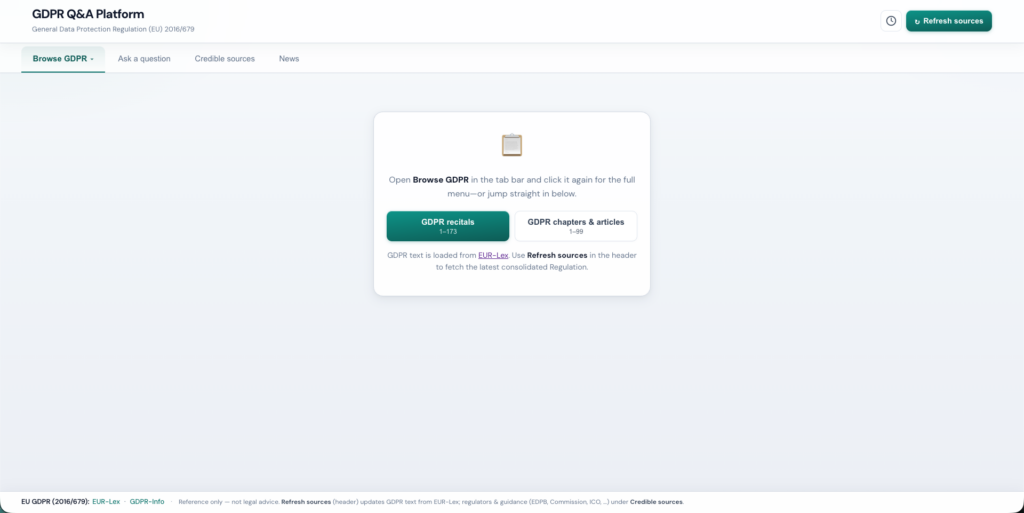
The Browse GDPR feature provides a structured entry point to the full text of the regulation, starting from the homepage where clicking the “GDPR Q&A Platform” logo resets to the Browse tab. Users see intuitive placeholders prompting selection of GDPR recitals (numbered 1 to 173), chapters and articles (11 chapters spanning Articles 1 to 99), or credible sources. The reader sidebar clears to a neutral state, establishing a consistent home base for exploration. Navigation segments clearly label recitals or chapters with Roman numerals, titles, and article ranges, all prefixed with “GDPR” to distinguish future expansions like other regulations. This design ensures users quickly orient themselves within the regulation’s architecture without confusion.
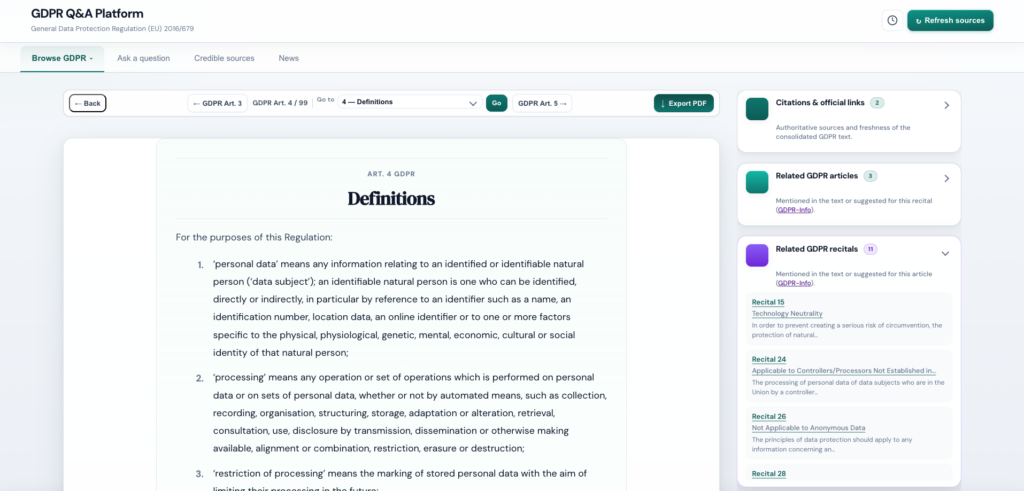
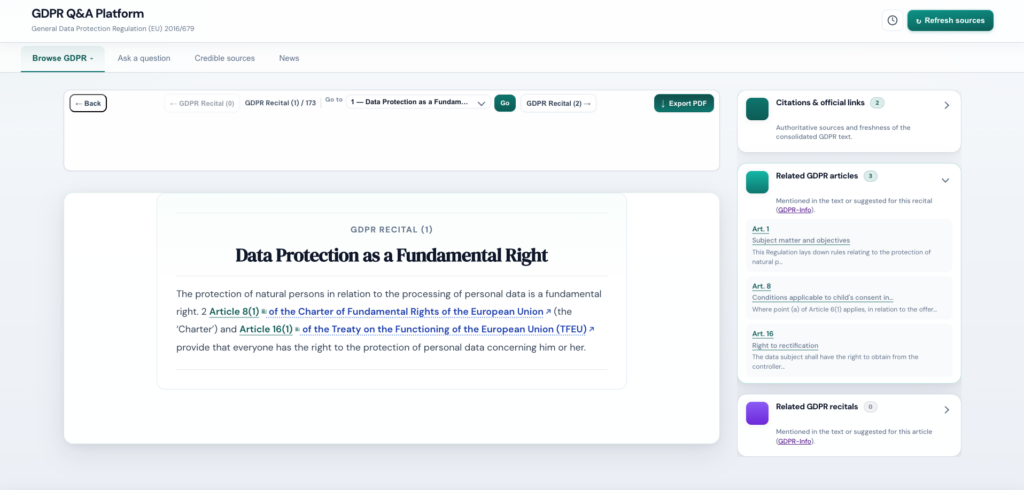
Filters form a dedicated bar with rows for Category (chapter title), Sub-category (derived from article keywords like Consent or Transfers), Chapter, and Article. Selections dynamically populate related options, such as limiting sub-categories to those within a chosen chapter, and the responsive layout adapts to single-column on mobile or two-column grids on desktops. A “Clear filters” button resets everything instantly. Recitals appear as a grid of clickable cards that expand into detail views with formatted body text and citation links, while chapters and articles group under centered headers (ex: “Chapter I – General provisions”) with meta like article counts and optional short introductions fetched from /api/chapter-summaries, regeneratable via Groq.
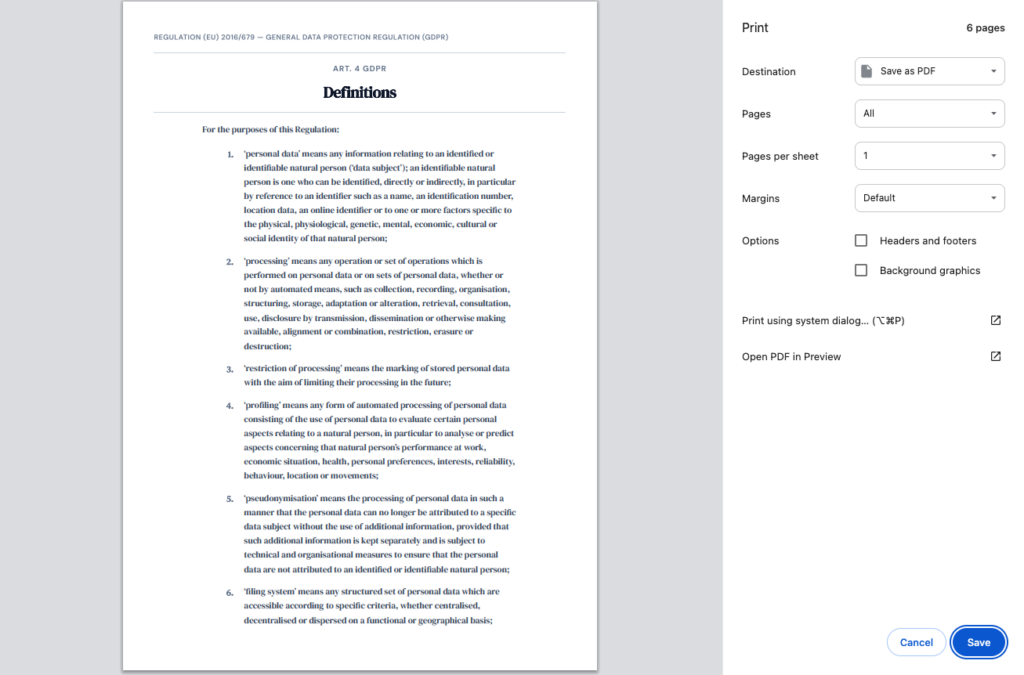
The detail view centers a header naming the chapter or official sources (GDPR-Info, EUR-Lex), with Prev/Next buttons, current position labels (ex: “Article 5 of 99”), and a numbered input for jumping to any article or recital. PDF export captures the current document, and if accessed from the Ask tab, a “Back to question” button scrolls back precisely. Related panels display cross-references like suitableArticles or suitableRecitals from editorial JSON and extracted citations, with all views linking to primary sites for verification.
Ask a Question
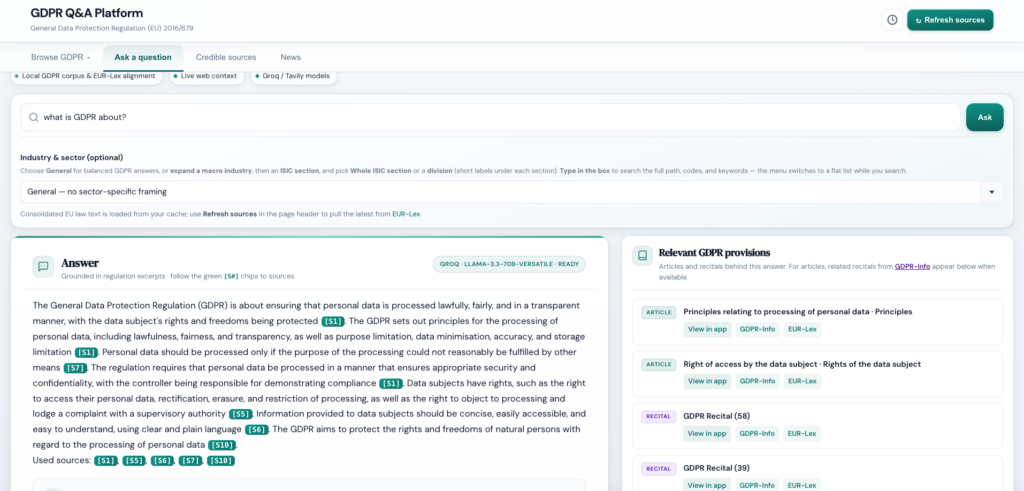
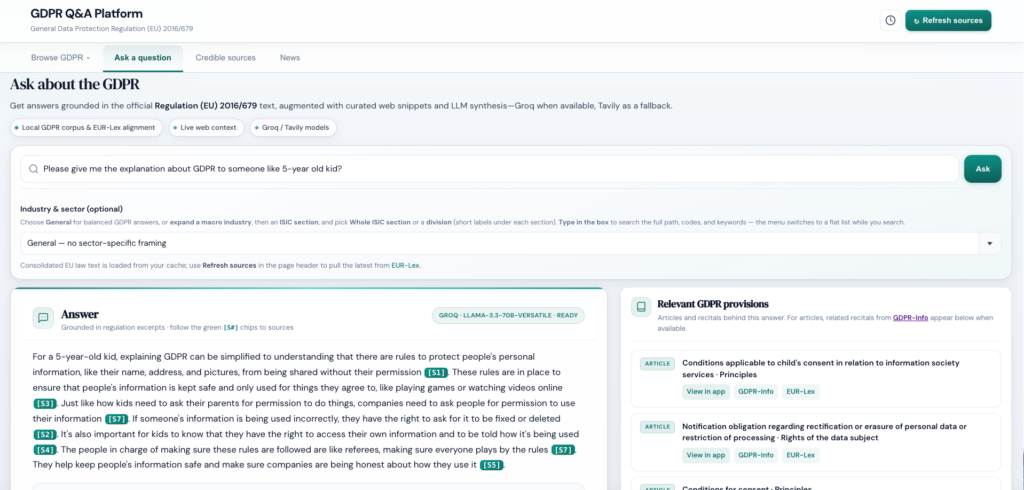
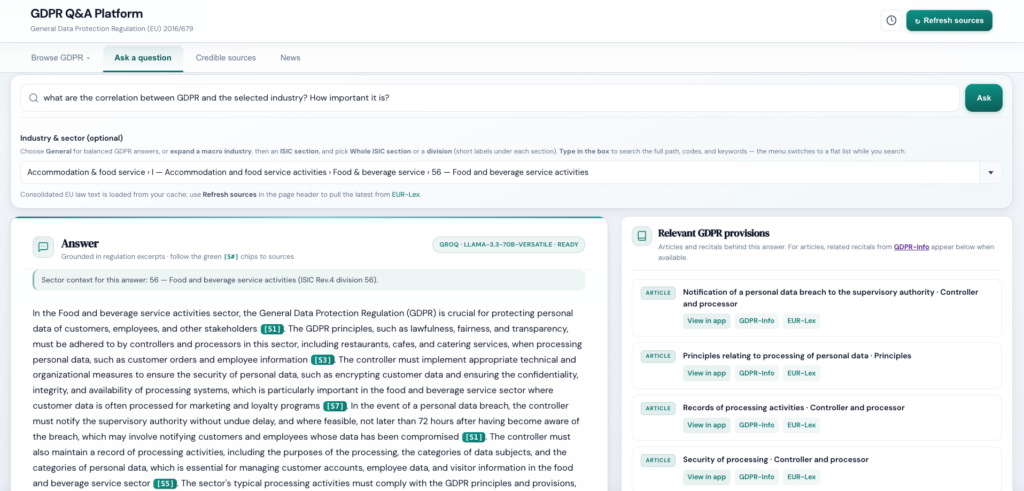
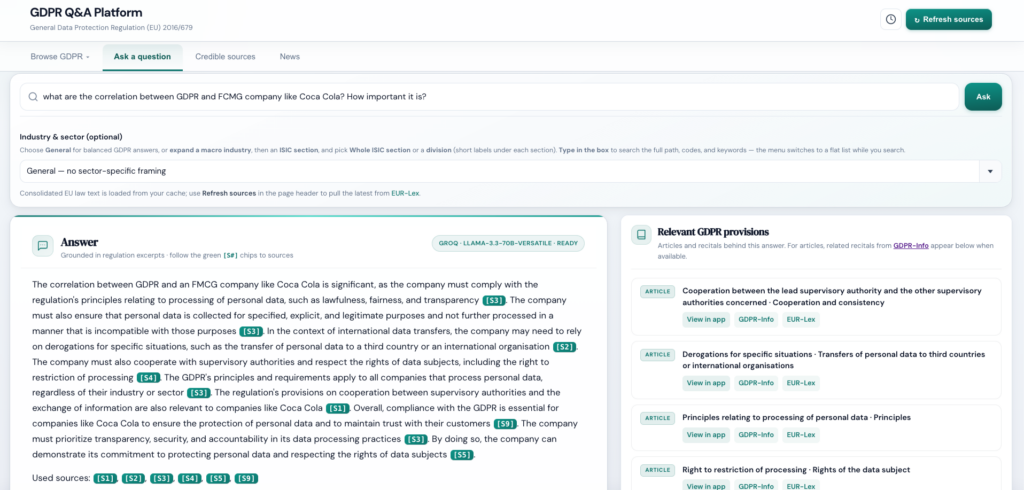
Users enter free-text questions in the search input, such as “What is personal data?” or “Right to erasure,” submitting via button or Enter to trigger POST /api/answer with parameters for query, web inclusion, and optional industry sector. The server constructs a BM25-ranked context from the searchIndex, supplements with DuckDuckGo HTML excerpts if requested, then generates responses via Groq chat completions. Fallbacks include Tavily search-and-answer or extractive summaries from top regulation snippets, ensuring reliable outputs even under load. An industry/sector combobox from /api/industry-sectors adds verbatim phrases from sector definitions when applicable, tailoring responses without hallucination.
The answer panel displays synthesized text inline with [S1]-style citation chips: regulation chips open the exact Article or Recital in Browse, while web chips launch external URLs. A status chip notes the model (Groq/Tavily) or fallback mode, plus any server annotations for transparency. An aside lists relevant GDPR provisions with “View in app” links for deeper dives. Each new question refreshes the panel, clearing prior citations and lists to maintain focus on the current query .
A legacy POST /api/ask endpoint persists for simple token-scored full-text matches, ideal for scripts or integrations, though the Ask tab exclusively uses the advanced /api/answer pipeline. This layered approach balances conversational intelligence with fallback reliability, making complex queries accessible while grounding every response in verifiable sources.
Credible Sources
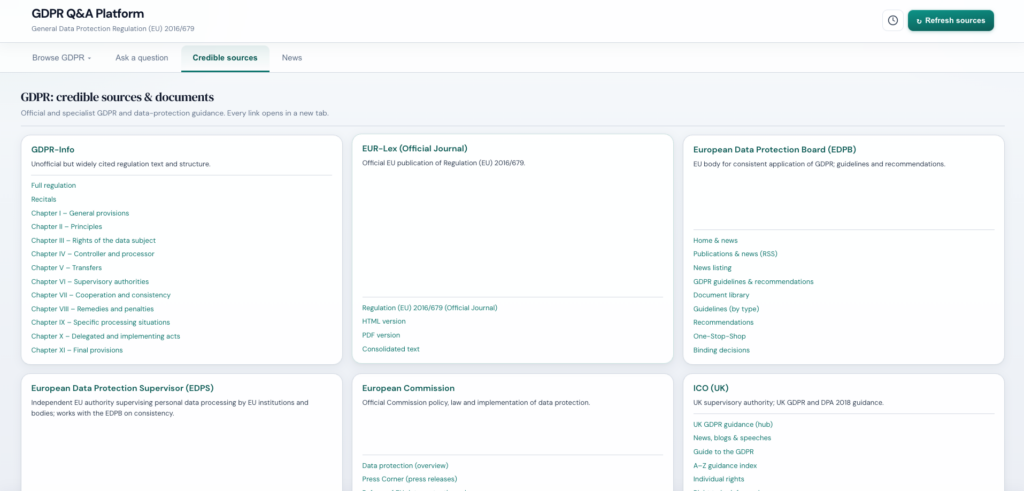
The Credible Sources tab lists trusted organizations including GDPR-Info, EUR-Lex, EDPB, European Commission, ICO, GDPR.eu, and Council of Europe, each with concise descriptions and hyperlinks to pivotal documents like guidelines, recitals, chapters, or ICO guidance. Data populates dynamically from GET /api/meta’s sources array, ensuring the list reflects the latest curated references. This centralized hub serves as a launchpad for external deep dives, complementing the platform’s internal corpus.
By curating only high-authority entities, the feature reduces the overwhelm of scattered web searches, directing users straight to foundational resources. Short descriptions contextualize each source’s role, such as EDPB for binding decisions or ICO for UK-specific enforcement, fostering informed navigation.
Content Refresh
Users trigger a full content update with a simple button press, which pulls the latest regulatory texts from trusted sites and processes them into a clean, searchable format. The system standardizes document layouts, checks formatting quality, rebuilds the internal index for fast queries, and saves the refreshed data securely on the server. Caches clear automatically, and the app reloads lists, sources, and open documents to reflect updates seamlessly. By default, it prioritizes GDPR-Info for comprehensive coverage, with an easy switch to EUR-Lex for official EU texts, plus options to force saves after custom tweaks.
Scheduled automation runs daily at 2:00 AM Brussels time, or via command line for developers, handling the full update cycle without needing the web interface running. Dedicated guides explain formatting rules to maintain consistency across sources. This keeps the platform’s knowledge always aligned with the most current official publications.
Core anchors remain GDPR-Info and EUR-Lex, supplemented by quick links in the Sources tab and footer for direct access to originals, guaranteeing every piece of content traces back reliably.
News from Credible Sources
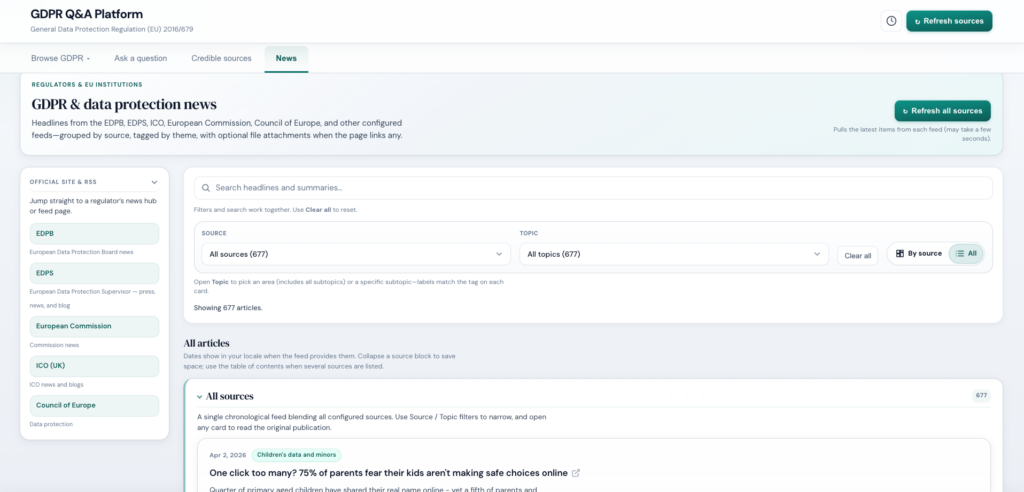
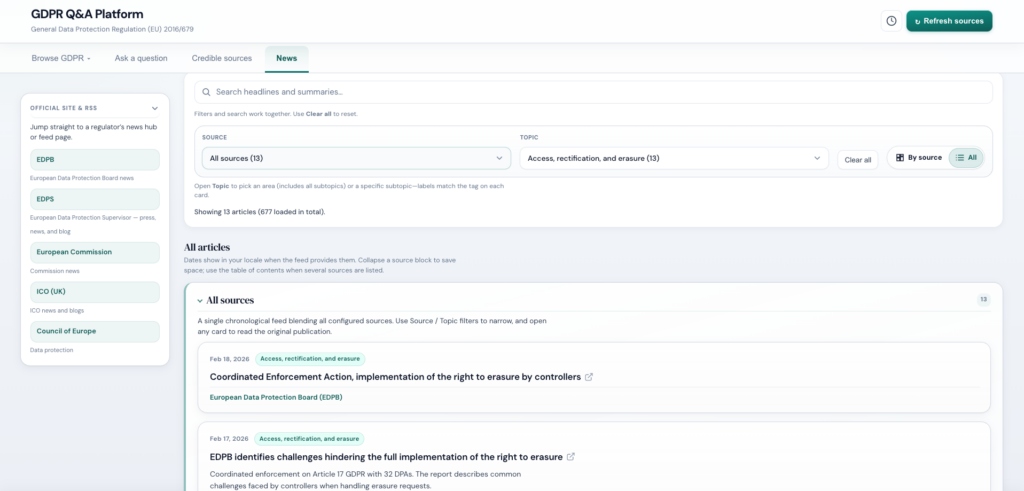
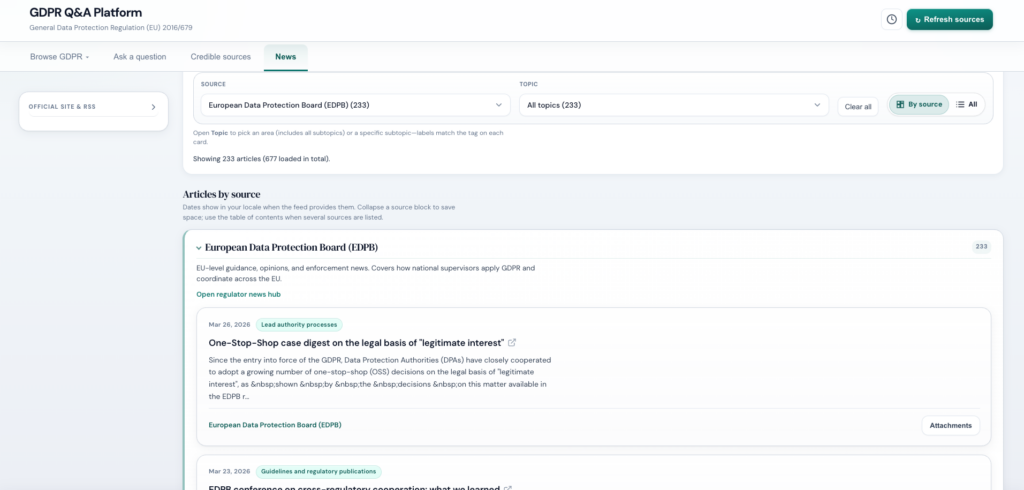
The News tab gathers the latest GDPR and data protection updates, organized neatly by trusted sources like EDPB, ICO, European Commission, and Council of Europe. Each news item appears as an easy-to-scan card with a clear three-paragraph summary: the first gives a quick overview of the development, the second credits the source with a direct link to the full article, and the third explains its relevance to everyday compliance work. Handy tags such as Rights (erasure & access), AI & digital, or Enforcement & fines appear right on the cards, letting you spot key themes at a glance. Simple filters for Source or Topic work instantly on your screen, and a “Clear filters” button brings back everything effortlessly.
A refresh button pulls in fresh content from these reliable feeds, blending new stories with existing ones while removing duplicates, sorting by date, and keeping the list focused. Behind the scenes, it updates the app’s news collection and refreshes your view without delay. This setup ensures you stay current on enforcement trends, guideline changes, and regulatory shifts, all in one dedicated space without needing to browse external sites.
Users access news through straightforward lists of feeds and items, complete with titles, links, previews, summaries, and topics. Whether checking fines, AI guidance, or cross-border rules, the tab delivers timely insights tailored to compliance professionals who need actionable updates fast.
Optional LLM Summaries
For external tools or custom setups, a dedicated summary feature lets developers generate concise overviews from selected text excerpts paired with a specific question. It tries leading AI providers in order, starting with the most reliable options available through your configuration, ensuring flexible and high-quality results. This keeps integrations smooth for teams building on top of the platform’s regulatory data.
The main Ask tab sticks to its primary question-answering flow, which combines search, web context, and AI generation in one seamless process, bypassing this summary option entirely. This focus delivers the richest, most comprehensive responses right in the app.
Older layouts that split screens between raw text excerpts and added summaries belong to earlier versions. The current design centers on a unified, citation-rich answer panel that makes compliance insights immediately actionable and easy to verify.
Documentation & Sources
The GDPR QnA Platform is thoroughly documented in its GitHub repository, which provides clear explanations of the platform’s logic, data structure, core features, and regulatory corpus handling as well as links to relevant references and dependencies.
Product Documents
The documentation in the GitHub repository covers several key areas of the platform.
Architecture
This document outlines the data flow, component boundaries, and technical architecture of the GDPR QnA Platform. It aligns with the Product Documentation Standard and supports engineering onboarding as well as feature-to-code mapping for Browse, Ask, and refresh pipelines. It complements the tech stack and guidelines described in the README and PRD, using professional wording for clarity and easy reference.
View Architecture Documentation →
Content Pipeline & ETL
This document explains how the platform scrapes, normalizes, indexes, and refreshes GDPR content from primary sources like GDPR-Info and EUR-Lex. It follows the Product Documentation Standard and describes the ETL process, formatting guardrails, search index builds, and cache invalidation flows. For detailed definitions of corpus variables such as document hashes, article counts, and refresh triggers, see DOCUMENT_FORMATTING_GUARDRAILS.md. For API configurations and environment variables, refer to server.js and .env examples.
View Content Pipeline Documentation →
Product Requirements Document (PRD)
The PRD serves as the single source of truth for all product requirements for the GDPR QnA Platform. It includes the product overview, compliance pain points, goals, scope, and detailed feature descriptions for modules such as Browse GDPR, Ask questions, Credible sources, News feeds, and content refresh. It also covers data processing rules, non-functional requirements, and business and technical guidelines that shape how the platform indexes, queries, and presents regulatory content.
View PRD →
Product Documentation Standard
This document defines the professional documentation standards followed across the GDPR QnA Platform project. Every file includes sections such as product overview, benefits, features, logic, business and technical guidelines, and tech stack details. The goal is to maintain consistency, clarity, and a single source of truth for anyone who reads, extends, or contributes to regulatory exploration features.
View Documentation Standard →
Product Metrics Documentation
This document explains how the GDPR QnA Platform measures success and how those metrics are aligned with both product and engineering objectives. It follows the Product Documentation Standard and describes engagement indicators, feature‑level usage, and how these support broader personal productivity goals. For detailed definitions of app‑level metrics such as time‑logging frequency, session length, and reflection patterns, see PRODUCT_METRICS.md. For all variables used across configuration, data, and environment files, refer to VARIABLES.md.
View Metrics and OKRs Documentation →
User Personas
This document describes the primary users of the GDPR QnA Platform, outlining their roles, compliance challenges, goals, and success metrics when navigating regulations. It guides feature prioritization and informs user stories, helping align platform behavior with real workflows for product managers, DPOs, and developers. Each persona reflects benefits such as source traceability, conversational querying, and instant article access.
View User Personas →
User Stories
User stories are grouped by feature area (Browse, Ask, News, Refresh) and mapped to the personas defined in compliance documentation. Each story includes clear acceptance criteria and follows the Product Documentation Standard to ensure product logic, behavior, and testability remain consistent and easy to trace. This structure keeps the platform focused on practical regulatory use cases.
View User Stories →
Variables Documentation
This document serves as the single reference for all variables used in the GDPR QnA Platform. It lists each variable’s name, friendly name, definition, default value, and usage context, along with practical examples. It also describes how variables relate to one another and how data flows from scraped sources to indexed content, helping maintain clarity across product, design, and engineering considerations.
View Variables Documentation →
Tech Stacks
The GDPR QnA Platform relies on a streamlined, open-source technology stack optimized for fast regulatory text processing, conversational querying, and local content management without external dependencies.
- HTML5 forms the backbone of the frontend interface, structuring tabs like Browse, Ask, News, and Sources for semantic accessibility, responsive grids (recital cards, filter bars), and detail views with navigation elements like Prev/Next and PDF export buttons.
- Vanilla JavaScript (client-side) and Node.js (server-side) drive dynamic behaviors: frontend handles filter interactions, citation chip expansions, chat inputs, client-side news filtering, and UI refreshes post-API calls; backend powers APIs (/api/answer with BM25 ranking + Groq/Tavily), scraper.js ETL, searchIndex builds, and endpoints like /api/refresh/meta/news.
- CSS (vanilla with responsive media queries) styles the clean, professional layout—grid-based recital/chapter lists, centered headers, expandable related panels, status chips, and mobile-optimized filter rows—ensuring focus on content without visual clutter across devices.
- Server-side JSON files (data/gdpr-content.json, data/gdpr-news.json) and fs.writeFileSync store the normalized corpus (articles/recitals with guardrails), search indexes, news items, and meta data locally, enabling instant offline access to indexed content after ETL runs.
- GitHub repository centralizes version control, README setup instructions (npm install, npm run dev/refresh), docs (ARCHITECTURE.md, PRD.md, DOCUMENT_FORMATTING_GUARDRAILS.md), source code (server.js, scraper.js, news-crawler.js, gdpr-crossrefs.js), and issues for transparency, contributions, and compliance audits.
Use Cases
The GDPR QnA Platform is built on the goals to cover several use cases / scenarios such as
Query Compliance Questions
As a Product Manager, I want to ask natural language questions about GDPR articles or principles, so that I receive clear answers with source citations.
Acceptance Criteria:
- Relevant provisions list appears instantly with “View in app” buttons .
- Free-text input accepts queries like “What is personal data?” or “Right to erasure requirements.”
- Answer panel shows synthesized response with clickable [S1]-style regulation chips linking to Browse tab.
Browse Articles and Recitals
As a Compliance Officer, I want to navigate chapters, articles (1-99), and recitals (1-173) with filters, so that I can locate specific regulatory text quickly.
Acceptance Criteria:
- Filter bar supports Category, Sub-category (Consent, Transfers), Chapter, and Article selections with dynamic options.
- Detail view includes Prev/Next navigation, jump-to-number input, and PDF export button.
- Related articles/recitals panels load from cross-reference data automatically.
Refresh Regulatory Content
As a DPO, I want to update the GDPR corpus from primary sources, so that interpretations reflect the latest official texts.
Acceptance Criteria:
- Refresh button triggers ETL pipeline pulling from GDPR-Info/EUR-Lex with formatting guardrails.
- Client automatically reloads lists, sources, and open documents post-refresh.
- Success feedback confirms search index rebuild and cache invalidation.
Review Credible Sources and News
As a Legal Team Member, I want to access curated sources and recent enforcement news, so that I stay informed on guidelines and cases.
Acceptance Criteria:
- Sources tab lists EDPB, ICO, EUR-Lex etc. with document links from /api/meta.
- News tab shows grouped cards with three-paragraph summaries, topic tags, and client-side Source/Topic filters.
- News refresh merges crawled items without duplicates, sorted newest first.
Sector-Specific Compliance Answers
As an Industry Specialist, I want answers tailored to my sector (fintech/healthcare/AI), so that responses include relevant regulatory context.
Acceptance Criteria:
- Industry combobox from /api/industry-sectors injects verbatim sector phrases into Groq prompts.
- Status chip indicates sector-aware processing vs. general responses.
- Fallbacks (Tavily, extractive) maintain citation integrity even without sector data.
Why I Built the App
The idea to build the GDPR QnA Platform emerged from years of frustration with scattered regulatory documents that disrupted compliance workflows during product development. As a product manager working across e-commerce, edtech, and mobility industries, I repeatedly faced the same challenge: official GDPR texts from EUR-Lex and GDPR-Info competed for attention with EDPB guidelines, national authority interpretations, and internal policy mappings, all spread across dozens of browser tabs, half-downloaded PDFs, and fragmented notes. This constant context-switching turned what should have been focused analysis into exhausting scavenger hunts, where locating Article 25’s data protection by design requirements or recital 78’s technological neutrality meant rebuilding mental models from scratch each time. I began treating GDPR like any complex system I needed to master, mapping the 99 articles and 173 recitals as inputs that should produce clear outputs like feature alignments and risk assessments, rather than forcing teams to memorize clause numbers or guess enforcement priorities.
My passion for data products and structured compliance workflows drove me to create a tool that indexes authoritative GDPR sources into a unified, searchable knowledge base. I wanted to eliminate the mental overhead of manual cross-referencing while preserving complete traceability to primary sources like GDPR-Info and EUR-Lex. The platform delivers this through its Browse tab for structured navigation of chapters and articles, Ask tab for conversational queries with citation chips, and refresh mechanisms that keep content current. Product specialists gain instant clarity on complex requirements without documentation chaos, transforming compliance from scattered research into authoritative, source-grounded decision-making that respects regulatory precision.
What I Learnt from the App Development
The most relatable lesson from developing the GDPR QnA Platform came from treating this personal project like a startup serving its creator as the sole, unforgiving user. Every day spent building forced direct confrontation with my actual compliance pain points: opening endless tabs across GDPR-Info, EUR-Lex, EDPB guidelines, and scattered notes just to cross-check Article 25 against a product feature. If the Browse tab filters confused me during testing or the Ask tab delivered unclear answers, my future self paid the price during real product reviews, staring at clunky layouts and second-guessing why navigation felt so fragmented. This relentless self-testing turned decisions about filter row clarity, citation chip design, and Prev/Next button placement into genuine exercises in user empathy, where my daily regulatory struggles became the ultimate measure of practical utility.
This project delivered a humbling reminder that simplicity ranks among product development’s toughest achievements. Just when the Browse tab navigation felt intuitive and the Ask feature delivered clear citations, temptations arose to add complex visualizations or external integrations that would dilute focus. Real discipline meant staying true to the core mission: delivering GDPR’s 99 articles, 173 recitals, and credible sources through clean structured browsing and reliable question answering. Saying no preserved the filter bar’s clarity, maintained the detail view’s focused layout with Prev/Next navigation, and kept the Sources tab as a straightforward reference hub. Each rejected complexity made the platform genuinely more useful for daily compliance reviews, proving that restraint creates tools people actually use rather than admire.
Finally, building revealed how AI accelerates execution while product fundamentals determine true value. Code generation sped up scraper pipelines and search index logic, but decisions about cross-reference panels, refresh mechanisms, and industry sector integration stemmed from years shaping data products and compliance workflows. Analytics experience prioritized regulatory text precision over conversational fluency, product management discipline rejected feature creep, and engineering pragmatism favored local JSON persistence over cloud complexity for privacy-sensitive work. The GDPR QnA Platform demonstrates future development succeeds through AI augmenting human judgment, where rapid prototyping serves disciplined focus on solving authentic regulatory navigation challenges for product teams and compliance professionals.