

Imagine starting your Monday as a product specialist at a buzzing SaaS startup, juggling endless stakeholder meetings, Jira tickets that multiply like rabbits, and that nagging feeling your team’s building features nobody asked for. You’ve got the tech chops from your computer science days, but wrangling cross-functional chaos into something that actually wins in the market? That’s where the real adventure begins, complete with coffee-fueled all-nighters and those “aha” moments that make it all worthwhile. Product vision, product strategy, and product tactics form the foundational hierarchy of product management, where vision provides the inspirational “why,” strategy defines the “what” and “how” to win in the market, and the roadmap tactics handle the “when” and “who”.
Fast-forward to Q3, when your visionary “seamless world for remote teams” dream clashes with a competitor’s shiny new AI tool, forcing a hilarious pivot from pet features to laser-focused experiments that boost retention overnight. Suddenly, you’re the hero translating lofty goals into sprint wins, high-fiving devs over AB test triumphs, and charming execs with dashboards proving ROI, all while dodging the classic trap of tactic overload that turns roadmaps into wish lists. This hierarchy isn’t just theory, it’s your secret weapon for turning product frenzy into focused magic that delights users and keeps your portfolio sparkling.
Drawing from hands-on product escapades, chats with fellow product pals over coffee, and marathons of product management podcasts and books, here’s the fun lowdown on vision, strategy, and tactics.
Product Vision
Product vision serves as the foundational, inspirational cornerstone of product management, encapsulating the long-term aspiration and ultimate purpose of the product in a way that unites cross-functional teams, executives, and stakeholders around a compelling future state. It distinctly outlines the target customer segment, the fundamental problem or pain point being addressed, and the transformative value or outcome delivered, often distilled into a concise, memorable statement, such as “A world where every team collaborates seamlessly without barriers”, that evokes emotion and clarity without delving into tactical implementation details. This articulation acts as an enduring “north star,” guiding decision-making across the product lifecycle, from ideation to scaling, by ensuring all initiatives ladder up to this singular, ambitious goal.
Key Components
Developing a robust product vision involves collaborative workshops with key stakeholders, leveraging techniques such as vision boxing, which uses a one-page canvas to capture the customer, problem, solution, and success metrics, or storytelling exercises that make the vision vivid and relatable. Effective visions are inspired by the SMART framework: Specific enough to inspire, Measurable in outcomes, Ambitious to stretch capabilities, Relevant to market evolution, and Time-bound within a typical horizon of three to five years. At the same time, they must remain flexible to accommodate pivots that stem from user feedback, competitive shifts, or technological advancements. Product visions are revisited annually or during major milestones such as funding rounds or market expansions, and they are embedded in organizational rituals, including kickoff meetings, sprint retrospectives, and all-hands sessions, to maintain alignment and motivation during day-to-day execution. There are several key components that contribute to creating an effective product vision.
- Target Users
The target users element precisely identifies the primary customer segment or personas the product serves, grounding the vision in real human needs rather than abstract markets. For instance, specifying “overworked remote teams in fast-scaling startups” narrows focus from “all businesses” to a viable group with shared pain points, demographics, behaviors, and contexts, such as distributed engineers juggling Slack, email, and Zoom fatigue. This specificity enables tailored prioritization, like emphasizing mobile-first features for on-the-go users, and facilitates empathy-building through personas or journey maps during development.
- Problem Solved
Articulating the core problem addresses the specific pain, gap, or unmet need that the product resolves, framing the vision around customer frustration rather than generic features. In the example of “fragmented communication tools,” this highlights issues like context-switching delays, lost threads, and collaboration silos that erode productivity by 20-30% in studies on remote work. By naming the problem explicitly, the vision shifts discussions from “what to build” to “why it matters,” informing user research, competitive analysis, and success metrics like reduced task completion time.
- Desired Future State
The desired future state paints an aspirational, vivid picture of success post-product adoption, emphasizing transformation over incremental fixes. “Effortless, intuitive collaboration” evokes a world of seamless idea flow, zero-friction handoffs, and serendipitous discoveries, inspiring teams to innovate beyond current tools. This forward-looking element, often 3-5 years out, balances ambition with plausibility by rooting it in emerging trends like AI-assisted workflows, ensuring the vision evolves with technology shifts while maintaining emotional pull.
- Unique Value Proposition
The unique value proposition (UVP) distinguishes the product by highlighting the singular benefit or “secret sauce” delivered, such as “joyful productivity at scale” that combines delight (for example, gamified interactions) with efficiency for enterprise growth. It answers “Why us?” by weaving in proprietary strengths like proprietary AI or ecosystem integrations, validated through differentiation frameworks like the Value Proposition Canvas. A strong UVP prevents commoditization, guides go-to-market messaging, and aligns pricing with perceived value.
The Guidelines on Effective Product Vision
Creating an effective product vision involves a structured, collaborative process that ensures the vision is clear, inspiring, and actionable for all stakeholders. It begins with a deep understanding of the core elements, including target users, their key problems, the desired future state, and the product’s unique value proposition. The process ultimately leads to a concise statement that aligns teams and guides long-term decisions.
- Engage Cross-Functional Stakeholders
Involve product managers, engineers, designers, marketers, sales, and customer support in workshops to gather diverse insights. Collaborative involvement generates buy-in and a shared sense of ownership.
- Conduct User Research
Use methods like interviews, surveys, and persona development to deeply understand your target users’ pain points, motivations, and unmet needs. Ground the vision in actual user problems rather than assumptions.
- Define Core Elements
- Target Users: Identify the primary audience segment with specific characteristics.
- Problem Statement: Clearly articulate the key problem or challenge the product solves for those users.
- Future State: Paint an aspirational picture showing how users’ lives improve with the product.
- Unique Value Proposition: Highlight what makes your product distinct and indispensable.
- Use Structured Templates and Exercises
Tools like Roman Pichler’s Product Vision Board or vision boarding exercises help organize and visualize the vision elements into a cohesive narrative.
- Draft and Refine
Write the vision statement collaboratively, keeping it concise (ideally 1-2 sentences), memorable, and inspirational. Avoid jargon, focusing instead on clarity and emotional connection.
- Validate
Test the vision with internal stakeholders using the elevator pitch method by checking whether they can recite and explain it clearly. In addition, validate the vision with customers through interviews or surveys to assess its appeal and practicality.
- Communicate and Reinforce
Embed the vision into company rituals, presentations, sprint planning, and strategic decisions to ensure it remains a guiding star over time.
- Review Periodically
Revisit the vision regularly (annually or after major pivots) to adapt to evolving markets, technologies, and customer insights without losing the core inspirational purpose.
Key Characteristics and Best Practices
Key characteristics and best practices define what elevates a product vision from a generic statement to a powerful, enduring guide that drives alignment, innovation, and execution across the organization. These traits ensure the vision is not only motivational but also practical, customer-validated, and strategically sound, directly influencing product success metrics like team velocity and market differentiation.
- Inspirational and Concise
Limited to 1-2 sentences, using vivid language to rally teams (for example, Slack’s “Be the world’s most trusted communication platform” fosters unity).
- Customer-Centric
Rooted in deep empathy, validated through user research like interviews or Jobs-to-be-Done frameworks, ensuring it resonates with real needs.
- Ambitious yet Achievable
Balances moonshot thinking with grounded feasibility, avoiding overpromising that leads to disillusionment.
- Differentiated
Highlights unique value against competitors, informing positioning from day one.
Common Pitfalls
Common pitfalls in crafting product visions undermine team alignment, lead to misguided strategies, and result in product failure, often stemming from confusion over purpose, lack of validation, or overly rigid thinking.
- Vague or Abstract Statements
Visions that sound inspirational but lack specificity fail to provide actionable direction, leaving teams directionless amid daily priorities. For example, generic phrases like “Be the best app” inspire no one and cannot guide decisions, as they omit target users or value. Avoid by grounding in concrete elements like user segments and outcomes, tested for clarity via stakeholder recitals.
- Company-Centric Instead of Customer-Centric
Writing from the company’s perspective, such as “Become the number one provider,” ignores user needs and erodes motivation, as it prioritizes internal ego over empathy. This shifts focus from customer transformation (for example, “less complexity in daily work”) to self-serving goals, reducing relatability. Counter with Jobs-to-be-Done research and user interviews to ensure 70%+ external resonance.
- Confusing Vision with Strategy, Mission, or Features
Blending vision with tactical details, such as target markets, business goals, or specific features (for example, “Easy UI and barcode scanner”), can cause overlap with strategy documents, which dilutes its inspirational purpose and restricts flexibility for future pivots. The vision should remain a high-level “why” that defines the desired future state, distinct from the mission, which explains the current “what” and “how.” Tools like Pichler’s Vision Board can help keep these layers clearly separated.
- Overly Detailed or Restrictive
Excessive specifics stifle innovation and flexibility, turning the vision into a rigid map rather than a compass, especially in fast-changing markets. Phrases locking into product ideas (for example, “Weight loss app”) prevent adaptation. Balance with broad ambition over 3-5 years, allowing creative exploration while maintaining core purpose.
- Untestable or Unvalidated Assumptions
Unrefined visions with broad needs (for example, “Get fit”) hide risks, making it impossible to select KPIs or validate via prototypes, leading to strategy failure. Causes include skipped research. Iterate with qualitative studies (observations, interviews) until testable, targeting specific benefits like “Run 10k non-stop”. - Lack of Differentiation or Measurable Goals
Weak standout features or vague business aims (for example, “Make money”) fail to differentiate from competitors or track success, complicating marketing and ROI assessment. Refine with UVP canvases and quantifiable targets (for example, “Double brand equity in 2 years”). Quarterly reviews prevent dust-gathering documents.
Product Strategy
Product strategy serves as the critical bridge between an aspirational product vision and executable reality, providing a high-level, actionable blueprint for achieving market success and sustainable business value. It systematically delineates target market segments, a compelling value proposition, competitive positioning, key performance metrics, and the go-to-market (GTM) approach, ensuring all product initiatives align with both customer demands and organizational objectives. By translating the “why” of the vision into the “what” and “how,” it empowers product leaders to prioritize ruthlessly, allocate resources effectively, and measure progress against tangible outcomes.
Key Components
Product strategy consists of a set of interconnected core components that create a cohesive framework for translating the product vision into market-winning execution. This framework ensures alignment with customer needs, business goals, and competitive realities. The key elements typically include vision linkage, target market definition, value proposition, market analysis, business objectives, go-to-market tactics, and success metrics. Together, these components establish the strategic guardrails that guide prioritization, resource allocation, and continuous refinement.
- Product Vision and Strategic Objectives
The foundation links directly to the overarching product vision, outlining 3-5 year aspirations, while defining specific, measurable objectives such as revenue targets (for example, $10M ARR) or adoption goals (for example, 1M MAU). This component sets the “what success looks like” via North Star Metrics and OKRs, ensuring every initiative ladders up to long-term value creation for users and the business.
- Target Market and User Needs
Precise identification of customer segments, achieved through personas, firmographics, or behavioral clusters (for example, “SMB e-commerce managers aged 25–40”), should be paired with deep insights into customer pains, jobs to be done, and preferences gathered through voice-of-customer programs, usability testing, and analytics. This customer-centric foundation helps avoid building for undefined audiences and instead focuses efforts on high-fit segments with validated demand signals.
- Value Proposition and Competitive Positioning
A compelling unique value proposition (UVP) maps product capabilities to user gains, differentiated via perceptual maps or SWOT against rivals (for example, “AI-powered personalization 3x faster than Competitor X”). This element claims market whitespace, informing messaging, pricing tiers, and feature bets that create defensible moats like network effects or data advantages.
- Market Analysis and Business Goals
Comprehensive scans of TAM/SAM/SOM sizing, trends, Porter’s Five Forces, and competitor benchmarks reveal key opportunities and risks. Aligned business goals, such as market share capture or LTV:CAC ratios greater than 3:1, drive financial modeling to ensure the strategy justifies investment through ROI projections and growth vectors outlined in Ansoff’s matrix.
- Go-to-Market (GTM) and Execution Pillars
GTM details channels (for example, freemium inbound, partnerships), distribution, sales motions, and packaging, while pillars like initiatives, feature roadmaps, and resource plans operationalize delivery. This includes budgets, timelines, and collaboration procedures to enable phased launches and feedback loops.
- Success Metrics and Initatives Map
KPIs across input (for example, velocity), output (for example, retention >60%), and outcome (for example, NPS >50) metrics form a dashboard for monitoring, with big bets and initiatives mapped to hypotheses for experimentation. Quarterly reviews keep the strategy adaptive amid pivots.
The Guidelines on Effective Product Strategy
Creating an effective product strategy is a disciplined process that bridges product vision and market execution, ensuring that every decision drives measurable business value while meeting customer needs. The strategy must be clear, data-informed, and adaptable, serving as a blueprint for prioritization, alignment, and continuous improvement across the product lifecycle. Below are comprehensive guidelines to craft a compelling and actionable product strategy.
- Align with Product Vision and Business Goals
Start by deeply understanding the product vision and company mission to ensure strategic coherence. Define specific, measurable objectives that contribute directly to overarching business goals (for example, revenue targets, market share). Use frameworks like OKRs to frame these objectives with quantifiable key results, creating a clear “definition of success” that unites stakeholders.
- Conduct Rigorous Customer and Market Research
Develop a thorough understanding of target users and markets through mixed-method research for anchoring the strategy in real-world evidence and uncovering unique market opportunities- Quantitative surveys for statistically significant trends
- Qualitative interviews to uncover underlying pain points, motivations, and context
- Jobs-to-be-Done frameworks to identify customer struggles and outcomes sought
- Competitive analysis including SWOT and Porter’s Five Forces
- Behavioral analytics and usage data to validate assumptions
- Identify Clear Target Segments and Positioning
Segment your market based on detailed personas, firmographics, or behavior patterns, targeting high-value customer clusters with validated demand signals. Craft a unique value proposition that differentiates your product from competitors, leveraging proprietary strengths (for example, AI capabilities, integrations). This UVP should guide branding, messaging, and feature prioritization.
- Define Strategic Pillars and Initiatives
Segment your market based on detailed personas, firmographics, or behavior patterns, targeting high-value customer clusters with validated demand signals. Craft a unique value proposition that differentiates your product from competitors, leveraging proprietary strengths (for example, AI capabilities, integrations). This UVP should guide branding, messaging, and feature prioritization.
- Develop a Go-to-Market Plan
Outline channels, pricing models, sales motions, and marketing tactics aligned with the strategy. Define how you will acquire, activate, and retain customers efficiently, integrating with sales and customer success teams. Plan for scalable infrastructure and feedback mechanisms that allow learning and adaptation post-launch.
- Establish Success Metrics and Feedback Loops
Develop a cohesive set of leading and lagging KPIs (for example, user adoption rates, retention, revenue metrics) aligned to strategic goals. Use these metrics to create dashboards and reporting cadences that inform decision-making. Build hypotheses for initiatives and conduct experiments or A/B tests to validate assumptions, ready to pivot based on data insights.
- Communicate and Document Clearly
Maintain the strategy in concise, visual formats such as one-pagers, strategy trees, or slide decks. Use collaboration tools for transparency and cross-functional alignment. Regularly communicate updates and rationale to all stakeholders, embedding the strategy into planning and review cycles to keep teams aligned and motivated.
- Review and Iterate Quarterly
Product strategy is a living document. Responsiveness and sustained alignment amidst changing conditions can be fostered by conducting quarterly reviews to:- Assess progress against metrics and OKRs
- Incorporate market and technology shifts
- Validate or pivot strategic priorities based on learnings
- Reallocate resources as necessary to maintain focus on highest-impact efforts
Key Characteristics and Best Practices
Effective product strategies exhibit distinct key characteristics that ensure they are actionable, resilient, and value-generating, while best practices provide the disciplined methods to embed these traits into development and execution. These qualities distinguish high-performing strategies, correlating to higher success rates in market adoption and revenue growth from vague plans that lead to misaligned efforts and wasted resources.
- Vision-Driven and Purposeful
A hallmark characteristic of effective product strategy is being anchored in a clear product vision and purpose that articulates the “why” behind the product, including who it serves, the transformation it delivers, and its market position. This foundation provides inspirational continuity and motivates teams through ambiguity, as seen in strategies that explicitly link to North Star aspirations like “empower seamless global collaboration.” Best practice involves cascading the vision into measurable objectives using OKRs, ensuring every pillar ladders up, and revisiting quarterly to maintain relevance amid pivots..
- Customer-Centric and User-Led
Superior strategies prioritize validated user needs over internal assumptions, deeply rooted in empathy from VoC data, JTBD insights, and behavioral analytics to address real pains like “async coordination silos.” This fosters resonance and retention, avoiding commoditized features. Best practice: Conduct ongoing mixed-method research (surveys n>500, interviews 20+), create personas for segmentation, and test UVPs via prototypes, targeting 70%+ user validation before commitment.
- Differentiated and Competitive
Strategies stand out by claiming unique value through proprietary strengths (for example, AI speed or ecosystem lock-in), informed by SWOT, perceptual maps, and competitor teardowns to occupy defensible whitespace. This drives premium positioning and moats like network effects. Best practice: Use Value Proposition Canvas to map gains/pains against rivals, A/B test messaging, and quantify differentiation (for example, “3x faster than X”) in documentation for GTM alignment.
- Actionable, Clear, and Specific
Clarity in targeting segments, goals, and decisions, while acknowledging uncertainties rather than ignoring them, enables precise prioritization and the ability to retrace steps. Vague strategies fail, but effective ones specify the “who, what, and how” without micromanaging. Best practice involves documenting in visual one-pagers or strategy trees that include falsifiable hypotheses, ownership, and timelines, along with RDCL (Real pain, Design, Capabilities, Logistics) or ICE scoring for ruthless focus.
- Flexible yet Stable (Adaptive)
Balancing stability in core pillars with agility for market shifts, these strategies evolve via feedback loops without losing direction, compounding value over time. Best practice: Institute quarterly reviews assessing KPIs (for example, ARR growth, retention >60%), A/B outcomes, and scenarios; sunset low-performers using 80/20 rule to reallocate dynamically.
- Collaborative and Measurable
Developed cross-functionally with visibility to all stakeholders, they include robust metrics (North Star, leading/lagging KPIs) for fluency in tracking progress. Best practice: Use tools like Aha! or Miro for co-creation, align on dashboards (LTV:CAC >3:1), and communicate via rituals like strategy sprints, ensuring 90%+ alignment scores.
Common Pitfalls
Common pitfalls in product strategy can severely undermine a product’s success by causing misalignment, wasted resources, and lost market opportunities. Recognizing and avoiding these traps is crucial for product leaders aiming to create impactful, sustainable strategies.
- Lack of Customer Focus
One of the most frequent errors is designing strategy around internal assumptions or competitor mimicry rather than validated customer needs. This results in feature bloat, low adoption, and poor retention because the product fails to address real pain points. Remedy with continuous user research and Jobs-to-be-Done frameworks.
- Overly Broad or Vague Objectives
Strategies that lack specificity, such as aiming broadly for “market leadership”, fail to provide actionable direction or measurable success criteria. This vagueness hampers prioritization and dilutes team focus. Craft clear, quantitative OKRs linked directly to measurable outcomes like ARR, MAUs, or churn reduction.
- Confusing Strategy with Roadmap or Vision
Blurring the lines between high-level strategy, detailed roadmaps, and aspirational vision can create confusion. For example, including granular feature lists or sales tactics in strategy documents dilutes strategic intent and restricts adaptability. Maintain clear distinctions and document each layer separately.
- Inflexibility and Resistance to Change
Rigid strategies that don’t adapt to market feedback, technological shifts, or competitive moves quickly become obsolete. This delays pivots and innovation, increasing risk. Embed regular review cycles and embrace hypothesis-driven experimentation to remain agile.
- Ignoring Competitive and Market Analysis
Failing to conduct comprehensive SWOT and industry analyses results in missed threats and opportunities, leading to strategies disconnected from reality. Conduct ongoing competitor monitoring and market sizing to inform positioning and investment decisions.
- Poor Communication and Stakeholder Alignment
A strategy that isn’t clearly documented, communicated, and championed across teams leads to silos, duplicated effort, and misaligned goals. Use visual one-pagers, collaborative workshops, and regular update rhythms to build and sustain alignment.
Product Tactics
Product tactics represent the operational layer of product management, manifested as precise, short-term actions and decisions that translate product strategy into tangible progress and immediate value delivery. Unlike the enduring “why” of vision or the mid-term “what” and “how” of strategy, tactics focus on the “when,” “who,” and “how much” through iterative execution. This includes activities such as feature development, A/B testing, marketing activations, pricing adjustments, and process optimizations, generally spanning from days to quarters to enable rapid learning and adaptation in dynamic markets.
Key Components
Product tactics, as the executional foundation of product management, comprise a set of core components that translate high-level strategy into measurable, short-term deliverables, emphasizing speed, experimentation, and adaptability to generate immediate value while feeding insights back upward. These components such as prioritization mechanisms, specific action plans, resource allocation, experimentation frameworks, measurement systems, and alignment tools ensure tactics remain tightly coupled to strategic goals, enabling teams to achieve 2-3x faster iteration cycles and higher outcome delivery rates through disciplined, data-driven operations.
- Prioritization Mechanisms
At the heart of tactics lies rigorous prioritization to select high-impact actions from the strategy’s pillars, using frameworks like RICE (Reach, Impact, Confidence, Effort), ICE scoring, or MoSCoW (Must/Should/Could/Won’t) applied to sprint backlogs or quarterly initiatives. This component filters infinite possibilities into 5-7 focused items per cycle, such as tagging features by strategic themes (for example, “retention booster: gamified streaks”) and scoring them quantitatively (for example, ICE >7 threshold), preventing diffusion of effort and ensuring 80%+ alignment with OKRs.
- Specific Action Plans and Deliverables
Tactics break strategy into granular, time-bound plans, including sprint goals (for example, “Deliver AI summary MVP in Sprint 42”), release timelines (bi-weekly with hotfix cadences), and task breakdowns via user stories or definition-of-done checklists. Examples encompass feature specs (wireframes to code), marketing activations (email campaigns targeting 15% open rates), or operational tweaks (onboarding flow A/B variants), all documented in tools like Jira or Linear for traceability and velocity tracking.
- Resource Allocation and Execution Assignments
Optimal tactics assign clear ownership, capacities, and dependencies, for example “3 engineers on core flow (80 story points), 1 designer for assets, PM for stakeholder sync,” using capacity models such as 70% allocation for planned work, 20% innovation, and 10% buffer. Cross-functional squads execute through daily standups and WIP limits, while scaling via automation like CI/CD pipelines to minimize handoffs and boost throughput.
- Experimentation and Iteration Loops
Embedded experimentation drives tactics through hypothesis-driven tests: A/B/multivariate trials (for example, “Test notification variants for 10% engagement lift”), prototypes, or canary releases with kill criteria (for example, <5% error rate). Weekly retrospectives incorporate feedback from user cohorts, analytics heatmaps, or NPS surveys, enabling pivots like “Deprioritize low-usage feature for bug debt,” fostering empiricism over opinion.
- Measurement and Success Tracking
Tactics mandate outcome-focused metrics layered across tactical (velocity, cycle time <7 days), output (features shipped), and impact KPIs (for example, activation +15%, churn -10%), visualized in real-time dashboards (Amplitude, Mixpanel). Post-mortems quantify ROI (for example, “Feature X drove $50K ARR”) and trigger escalations if thresholds miss, closing the loop to validate or kill initiatives swiftly.
- Alignment and Communication Tools
Sustaining fidelity to strategy requires traceability matrices (tactics-to-pillar mappings), rituals (sprint planning/reviews), and transparency platforms (Slack channels, Productboard), ensuring 90%+ stakeholder fluency. This component scales tactics across teams via standardized playbooks, turning isolated actions into compounded progress toward vision.
The Guidelines on Effective Product Tactics
Creating effective product tactics involves translating strategic objectives into clear, actionable, and measurable steps that drive immediate progress while maintaining alignment with broader product vision and strategy. These tactics enable product teams to operate with agility, experiment quickly, and deliver customer value incrementally. Below are comprehensive guidelines to craft and implement impactful product tactics.
- Break Strategy into Granular Actionable Tasks
Decompose high-level strategic pillars into specific features, experiments, marketing efforts, or operational initiatives. Define clear scope, expected outcomes, timelines (for example, sprints or quarters), and acceptance criteria for each tactic, using frameworks like user stories or job stories to frame deliverables from the user perspective.
- Prioritize Ruthlessly Using Data-Driven Frameworks
Apply prioritization models such as RICE (Reach, Impact, Confidence, Effort), ICE, or MoSCoW to select initiatives that maximize impact relative to effort and strategic fit. Limit work in progress to 5-7 high-value tactics per cycle to avoid dilution and ensure focus.
- Assign Clear Ownership and Resources
Allocate dedicated cross-functional teams or individuals with defined roles (product manager, developers, designers, marketers) and track capacity realistically (including buffers for unplanned work). Promote collaboration through daily standups, planning sessions, and transparent tools like Jira or Productboard.
- Embed Experimentation and Hypothesis Testing
Design tactics as testable hypotheses with clear success criteria (for example, lift in engagement or revenue). Use A/B testing, prototypes, or canary deployments to validate assumptions rapidly and incorporate learnings iteratively. Establish kill criteria to halt underperforming initiatives early.
- Measure and Monitor Outcomes Continuously
Set tactical KPIs aligned with strategic goals, spanning input metrics (velocity, cycle time), output metrics (features delivered), and outcome metrics (user activation, retention). Use dashboards and analytics tools for real-time tracking and conduct regular reviews to adjust course promptly.
- Maintain Alignment and Traceability
Ensure every tactic maps to strategic pillars and product vision to maintain coherence. Document this alignment in traceability matrices and update stakeholders regularly through sprint demos, retrospectives, and roadmap sessions to reinforce shared goals.
- Foster Agile Adaptability and Continuous Improvement
Adopt iterative planning cycles (weekly/biweekly sprints) with retrospectives to optimize processes and respond to market feedback or technology changes swiftly. Encourage a culture that values learning, transparency, and flexibility to pivot tactics without losing sight of strategy.
Key Characteristics and Best Practices
Key characteristics and best practices of product tactics define the operational excellence required to execute strategy with precision, speed, and measurable impact, distinguishing high-velocity teams that achieve faster time-to-value from those mired in inefficiency. These traits emphasize granularity, empiricism, and relentless alignment, ensuring tactics compound into strategic wins while enabling rapid adaptation to user feedback and market dynamics.
- Granular and Actionable
Product tactics excel when broken into hyper-specific, time-bound deliverables, such as “Ship AI notification variant A/B test by EOW with 10% engagement lift target,” avoiding vague directives that dilute focus. This granularity, spanning user stories, sprint goals, or campaign specs with definition-of-done checklists, enables parallel execution and quick validation. Best practice involves employing atomic task decomposition via INVEST criteria (Independent, Negotiable, Valuable, Estimable, Small, Testable) and limiting sprints to 5-7 items scored greater than 7 on RICE for maximum throughput without burnout.
- Data-Driven and Hypothesis-Led
Superior tactics operate as falsifiable experiments, framed as “We believe [action] for [user segment] results in [outcome] measured by [metric], tested because [assumption].” This empirical approach, using A/B tests, multivariate experiments, or canary releases, replaces gut feeling with evidence, allowing the cancellation of 30 to 50 percent of initiatives early to reallocate resources effectively. Best practice involves mandating hypothesis canvases with success criteria such as greater than 15 percent lift and kill criteria below 5 percent error, integrating tools like Optimizely or GrowthBook to ensure statistical rigor with a p-value under 0.05, and conducting weekly data reviews to enable decisive pivots.
- Agile and Highly Iterative
Tactics thrive on short feedback loops such as daily standups and bi-weekly sprints, with recalibration occurring weekly based on real-time signals like cohort retention drops or NPS dips, in contrast to the quarterly cadence typical of strategy. This dynamism allows for responsiveness to volatility, such as prioritizing urgent security patches over polish, while maintaining velocity at 80 or more story points per sprint. Best practice includes adopting Kanban WIP limits of 3 to 5 items per stage, conducting retrospectives using “Start, Stop, Continue” formats, and performing blameless post-mortems to improve processes, all targeting cycle times under seven days to achieve 90 percent predictability.
- Strategically Aligned yet Autonomous
Every tactic traces upward via thematic tags (for example, “Pillar 2: Retention”) and OKR contribution scores, preventing rogue efforts while granting squads autonomy for micro-decisions. This balance yields 90%+ alignment without micromanagement. Best practice: Maintain traceability matrices in Productboard/Jira, enforce sprint demos auditing strategic fit, and use 70/20/10 allocation (core work/innovation/buffer) to foster ownership across PMs, devs, and designers.
- Measurable with Multi-Layered KPIs
Tactics demand outcome obsession through tiered metrics: input (velocity >80%), output (features shipped), outcome (activation +20%), and business (ARR uplift $50K), visualized in Amplitude dashboards with automated alerts. This quantifies ROI, surfacing winners for scale-up. Best practice: Baseline pre-tactic (for example, 25% churn), set directional thresholds, and tie incentives to impact (for example, quarterly bonuses), conducting ROI audits to prune underperformers ruthlessly.
- Cross-Functional and Transparent
Effective tactics leverage squad models with blurred roles, where PMs focus on prioritization, developers on prototypes, and marketers on activation, supported by rituals such as planning poker and shared Slack channels. This transparency enables scaled execution across more than ten teams. Best practice includes standardizing playbooks, for example a “Launch Checklist,” co-locating virtually through tools like Miro, and benchmarking against industry standards such as Spotify’s squad health metrics, all while ensuring psychological safety to encourage candid escalation of blockers.
Common Pitfalls
Common pitfalls in product tactics derail execution by causing wasted effort, misaligned outputs, and stalled progress, often amplifying strategic weaknesses into operational failures that erode team velocity and delay value delivery. Product leaders must vigilantly avoid these traps to maintain momentum and adaptability.
- Lack of Strategic Alignment
Tactics disconnected from strategy, such as pursuing “shiny” features over high-priority pillars, create fragmented progress and stakeholder frustration, as efforts fail to compound toward OKRs. This manifests in backlogs bloated with low-impact items, diluting focus. Avoid by enforcing traceability matrices and RICE scoring weighted 40% by strategic fit, auditing 100% of sprint items in planning.
- Poor Prioritization Leading to Overload
Chasing too many initiatives without ruthless filtering overwhelms teams, spiking cycle times (>14 days) and burnout while delivering minimal outcomes. Classic symptoms include excessive WIP (>10 items/sprint) and “everything is priority 1” syndrome. Counter with strict limits (5-7 items/cycle), ICE/RICE thresholds (>7 score), and quarterly pruning of <20% performers.
- Absence of Clear Ownership and Accountability
Ambiguous roles, for example no single owner for a feature crossing PM and developer boundaries, breed finger-pointing, delays, and incomplete deliverables, which erode trust. Tactics stall in handoff limbo as a result. The remedy involves RACI matrices (Responsible, Accountable, Consulted, Informed), capacity-based assignments such as 70 percent planned work, and daily standups that surface blockers within 15 minutes.
- Neglecting Measurement and Experimentation
Executing without hypotheses, success criteria, or post-launch analytics turns tactics into guesswork, shipping features with zero usage (70% industry failure rate). No A/B tests or kill criteria perpetuates sunk-cost fallacies. Best defense: Mandate hypothesis statements (“If X, then Y by Z%”), statistical thresholds (p<0.05), and 48-hour post-mortems quantifying ROI.
- Inflexibility and Resistance to Feedback
Rigid adherence to initial plans ignores real-time signals like user drop-offs or competitor moves, missing pivot opportunities and accumulating tech debt. Weekly velocity drops signal this trap. Embed agility via WIP limits, blameless retrospectives (“What slowed us?”), and 20% buffer allocation for urgent responses.
- Siloed Execution Without Cross-Functional Collaboration
Isolated functions, such as developers building without designer input or PMs launching without marketing involvement, yield suboptimal products with high rework rates of 25 to 40 percent waste. Communication gaps amplify defects as a result. Foster squad models with joint planning, shared tools like Jira and Miro, and metrics such as deployment frequency greater than daily to synchronize efforts.
Interconnections and Flow
Vision anchors the triad as the unchanging compass, constraining strategy to vision-aligned choices, for example no consumer pivot for a B2B vision. Strategy decomposes into pillars that tactics execute, such as an “AI personalization pillar” yielding tactics like “prototype variant B by EOW,” with traceability matrices ensuring 90 percent fidelity. Tactics generate data, for example from failed tests revealing gaps, that refines strategy quarterly and rarely updates vision, forming a feedback pyramid where misalignment at any level cascades failure.
The Interconnections and Flow among Product Vision, Product Strategy, and Product Tactics
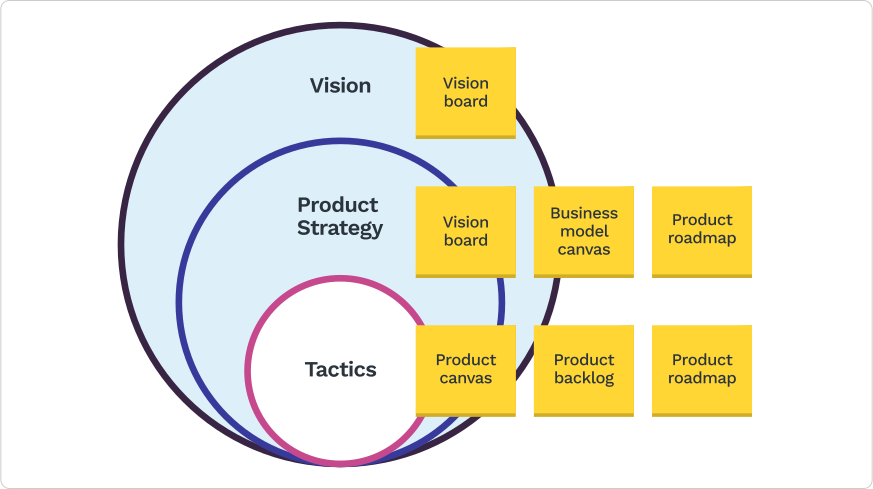
The Summary of Product Vision, Product Strategy, and Product Tactics
| Dimension | Product Vision | Product Strategy | Product Tactics |
|---|---|---|---|
| Time Horizon | Long-term (2-5+ years, stable) | Medium-term (1-3 years, quarterly reviews) | Short-term (days-quarters, weekly iteration) |
| Level of Detail | High-level, inspirational statement (1-2 sentences) | High-level plan (one-pagers, pillars, OKRs) | Granular actions (user stories, experiments) |
| Key Questions | Why? What future state? | What markets? How differentiate? | How/when/who execute? |
| Focus | User transformation, purpose | Markets, positioning, objectives | Features, tests, operations |
| Change Frequency | Rare (annual review) | Moderate (quarterly pivots) | High (daily/weekly adaptation) |
| Primary Audience | All stakeholders/execs | Leadership/cross-functional | Execution teams (PMs/devs/etc.) |
| Examples | “Earth’s most customer-centric company” (Amazon) | Target SMBs, AI USP, $5M ARR goal | Ship login flow A/B, 2-week sprint |
Practical Implications of Mastering the Vision-Strategy-Tactics Hierarchy
Mastering the distinctions among product vision, strategy, and tactics equips product leaders to avoid catastrophic pitfalls, fosters organizational alignment, and accelerates sustainable growth by ensuring every layer reinforces the others in a cohesive cascade. Imbalances lead to predictable failures: Vision without strategy results in aspirational drift, where teams feel inspired but directionless, chasing unrelated opportunities that dilute focus and burn resources without market traction. Strategy absent tactics stagnates as an elegant document gathering dust, with leadership debating hypotheticals while competitors execute. Tactics decoupled from vision and strategy produce random, low-value features that manifest as backlog bloat, technical debt, and eroding stakeholder trust.
Cross-Functional and Organizational Benefits
The triad scales enterprise-wide: Vision rallies executives for funding; strategy aligns sales and marketing on go-to-market plans; tactics empower autonomous squads with bounded autonomy, for example “Optimize within retention pillar.” This reduces silos, where cross-team velocity rises through shared rituals like strategy sprints, and builds resilience against volatility, such as regulatory shifts reprioritizing compliance tactics. Culturally, it instills outcome obsession, replacing heroics with systems: PMs prioritize via RICE weighted by strategy fit at 40 percent, developers prototype empirically, and marketers activate precisely, yielding predictable delivery and innovation flywheels.
Avoiding Escalation of Layer-Specific Pitfalls
| Imbalance | Consequence | Mitigation via Hierarchy |
|---|---|---|
| No Strategy (Vision Only) | Resource waste on unrelated experiments | Define 3-5 pillars with OKRs, quarterly OKR check-ins |
| No Tactics (Strategy Only) | Paper plans, missed launches | Mandate RICE-scored sprints, WIP limits (5-7 items) |
| No Vision (Tactics Only) | Feature factories, 70% unused code | Vision traceability tags, reject <7 ICE non-fits |
| Misaligned Layers | 40% effort dilution, trust erosion | Traceability matrices, 100% sprint audits |
In practice, technical product managers apply this by starting portfolio-wide: Audit backlogs for vision fit (prune 30%), score strategy pillars by impact (fund top 3), and sprint tactics with kill criteria (pivot 20% weekly). This disciplined flow transforms chaos into compounding value, positioning products as market leaders through relentless, evidence-based progression.
The Example of the Interconnection and Flow among Product Vision, Product Strategy, and Product Tactics
By examining Slack’s product vision, “Make work life simpler, more pleasant, and more productive,” we can better understand how a clear vision informs and connects to the subsequent layers of product strategy and product tactics.
Product Vision
“Make work life simpler, more pleasant, and more productive.” articulates an aspirational future state focused on transforming how people experience work, emphasizing ease, enjoyment, and efficiency. It is customer-centric and outcome-oriented, avoiding feature specifics, designed to inspire and align all stakeholders on a meaningful, long-term purpose.
Product Strategy
Building on this vision, the product strategy defines what success looks like and how to achieve it
- Target Market
Focus on knowledge workers in small-to-medium remote or hybrid teams struggling with fragmented communication and collaboration tools.
- Value Proposition
Deliver an integrated, user-friendly platform that unifies messaging, file sharing, and task management with intelligent automation to reduce context switching and manual coordination.
- Competitive Positioning
Differentiate by speed, intuitive UI, and seamless integrations with popular enterprise tools (for example, Google Workspace, Salesforce, Microsoft 365).
- Business Objectives
Achieve $100M ARR within 3 years; grow active users by 50% YoY; maintain NPS >50.
- Strategic Pillars
- Enhance asynchronous collaboration via AI-generated summaries and smart notifications.
- Expand partnerships with major SaaS vendors for ecosystem lock-in.
- Optimize onboarding for rapid adoption in distributed teams.
- Go-to-Market
Adopt a freemium model with tiered enterprise plans, inbound marketing focused on remote work benefits, and targeted sales outreach to tech startups.
- Key Metrics
Daily active user growth, retention rate improvements, reductions in average time spent switching apps, revenue growth.
Product Tactics
Tactics break down strategy pillars into specific, time-bound actions that deliver incremental value
- Sprint 1: AI-Powered Message Summarization Experiment
- Objective: Validate strategic pillar of asynchronous collaboration enhancement by implementing an A/B test for AI-generated thread summaries in group channels.
- Execution Details: Deploy variant A (summaries on-demand) vs. variant B (auto-generated with opt-out) to 10% user cohort; measure primary metric of engagement lift (+15% target in daily active messages) and secondary metrics (read time reduction >20%).
- Timeline & Governance: Complete development, QA, and launch within two-week sprint; statistical significance threshold (p<0.05) with 48-hour post-launch review; owned by PM/engineering squad with data analyst support.
- Sprint 2: Optimized Onboarding Experience
- Objective: Accelerate user adoption per onboarding pillar by developing interactive checklist feature with contextual tutorials and progress tracking.
- Execution Details: Integrate progressive disclosure flows reducing cognitive load; target time-to-first-message reduction of 20% (baseline: 8 minutes); A/B test against control group measuring activation rate and Day 1 retention.
- Timeline & Governance: MVP delivery in Sprint 42; user testing with 50 beta participants; rollback criteria if NPS drops <7.
- Q3 Marketing Activation: Thought Leadership Campaign
- Objective: Drive freemium acquisition supporting GTM pillar through targeted demand generation for remote teams.
- Execution Details: Launch 6-part webinar series on “Async Collaboration Mastery,” promoted via LinkedIn/Email (target 5K registrations); track conversion funnel from attendee → freemium sign-up (>8% target) and SQL generation.
- Timeline & Governance: Weekly episodes September-November; real-time optimization via UTM tracking in HubSpot; budget $50K with ROI threshold of 3:1 LTV:CAC.
- Q4 Engineering Integration Milestone
- Objective: Strengthen ecosystem pillar via Salesforce API integration enabling bidirectional task synchronization.
- Execution Details: Build OAuth-secured connector supporting custom objects; phased rollout (10% → 50% → 100% enterprise customers) with 99.9% uptime SLA; measure adoption (40% of eligible users activated within 30 days).
- Timeline & Governance: Alpha in October, GA December; comprehensive QA automation suite and customer beta program; contingency for API deprecation risks.
- Weekly Data-Driven Retrospectives
- Objective: Continuous improvement loop analyzing feature usage patterns via Mixpanel cohorts to refine backlog dynamically.
- Execution Details: Review funnel drop-offs (for example, 30% at search), session replays, and qualitative NPS feedback; reprioritize using updated ICE scores; action 3-5 backlog adjustments per session.
- Timeline & Governance: 60-minute Friday rituals; documented outcomes in Confluence with trend tracking.
- Bi-Weekly Cross-Functional Alignment Cadence
- Objective: Maintain tactical-strategic fidelity through synchronized execution across product, marketing, sales, and customer success.
- Execution Details: Review sprint velocity (target >80 story points), pillar progress (for example, 70% Q3 OKRs green), and market signals (competitor moves, churn drivers); adjust tactics collaboratively with consensus veto rights.
- Timeline & Governance: Alternating product/marketing leads; outputs feed quarterly strategy refresh; 90% attendance mandatory.
| Level | Core Elements | Example | Key Metrics/Outcomes | Time Horizon |
|---|---|---|---|---|
| Product Vision | Aspirational future state | “Make work life simpler, more pleasant, and more productive” | Inspirational alignment, stakeholder unity | 2-5+ years (stable) |
| Product Strategy | Target market, value prop, pillars, GTM, objectives | Target: SMB remote/hybrid teams -Value Prop:Unified messaging + AI automation -Pillars: Async collab, integrations, onboarding -GTM: Freemium → enterprise -Objectives:$100M ARR, NPS >50 | DAU growth, retention, app switch time ↓ | 1-3 years (quarterly review) |
| Product Tactics | Specific actions, experiments, campaigns | Sprint 1:A/B AI summaries (+15% engagement) -Sprint 2:Onboarding checklist (20% faster activation) -Q3 Campaign:Webinars (8% conversion) -Q4:Salesforce integration (40% adoption) -Weekly:Mixpanel retros -Bi-weekly:Cross-team sync | Velocity >80 pts/sprint, activation lift, ROI >3:1 | Days-Quarters (weekly iteration) |